
Jenny Moore’s experimental song-cycle Wild Mix is one of those pieces that seems to be dealing with the business of stripping back experience to its fundamental material, using the stage as a liminal space for introspection and interaction. The performers are dressed simply and the staging consists mainly of symbols rather than anything concrete from the real world. Much as its name suggests, it’s a varied, messy hotbed of creativity, bubbling over with words, music, light and physicality.
Though it’s an ensemble piece evoking and promoting togetherness, the core material is grouded in Moore’s real-life experiences. There’s a push and pull between the individual and the collective, the existential problem of being trapped in a body separate from those around it. The message clearly emerges as one of finding your people as a means to bridging that gulf.
The other performers weave around Moore, a Greek chorus helping her express and reconcile her inner demons. The night begins with the group’s close harmonies providing a bed for her candid, self-examining spoken word. She explores hefty topics like her relationship with her mother and God. She delves back into her teenage years, evoking her journey into womanhood, including an account of a mysterious sickness that plagued her adolescence.
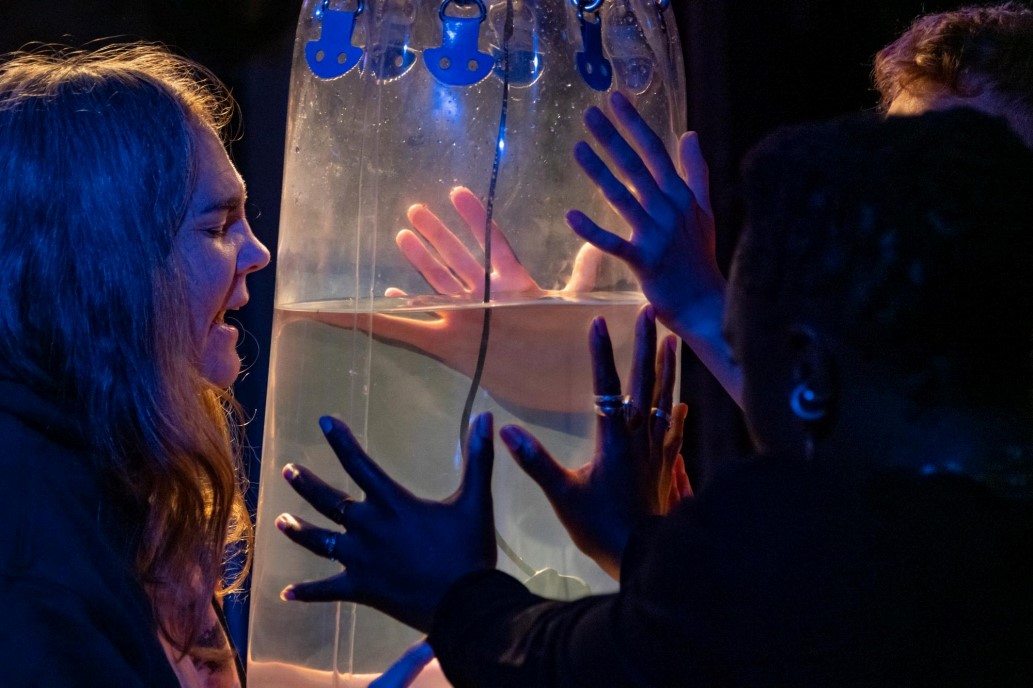
This sickness and its resistance to the probings of modern medicine brings about an othering of the body that is represented on stage by a transparent punching bag of water. It’s hoisted up with a hydrophone suspended inside to pick up the sloshing. It’s a stark and bold centrepiece to proceedings. During a particularly propulsive interlude one of the group relentlessly punches it to the time of the music and we’re left thinking about the physical onslaught that a body endures throughout a life.
It’s a very self-reflexive enterprise. The symbolism is blunt. The hydrophone amplifies the gurgling of the water in the punching bag as Moore shares and expresses what’s going on inside her. And there are admittances of limitation. The fourth wall is broken towards the end and she tells us what she’s been doing, that she’s been figuring out how to tell the story of a body, how to make the in-between alive. There’s a celebratory intimacy to these post-modern performance quirks, and a vulnerability that reflects the soul-searching subject matter of the songs and monologues.
For a member of the audience this dynamic can be tricky. We’re conditioned to expect that what is put before us is presented as a complete work, as close to perfect as possible. But it may be more thought-provoking to experience something like this, something joyously messy and exploratory, and maybe even patriarchy-smashing in its rejection of cherished norms.
Yes, there were parts that felt more successful than others. When Moore is left to herself with the punching bag to box an extended dance of self-hype, whilst the others sing a lamenting ballad, there’s a directness of emotion to her wordless performance that outshines the more verbose sections. The sad, slow song seems to get to her as she loses patience with the victorious boxing champion act and collapses into the punching bag with clinging world-weariness. And the surprise flashmob-esque appearance of the F*Choir delivers a real hit of community that builds to a generous climax of ecstatic positivity that leaves us wanting more.
ACCA | Thursday 29th January 2026
Photo by Katarzyna Perla
