
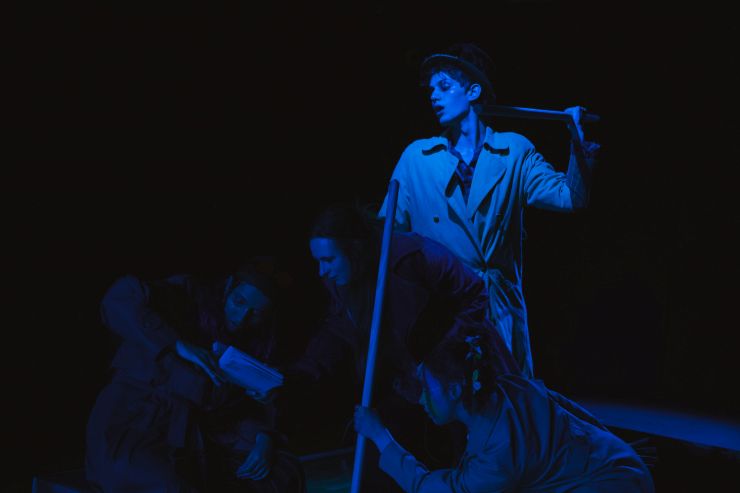
Fringe is often a place to experiment with theatre, and as a reprise from its Fringe slot Fate Train has that experimental energy. Siblings Max and Holly Hopkins have created a piece of theatre using Gods from Norse mythology as a way to process grief through the main character of Dawn, who has lost her partner on the day she was due to move in. Surrounded by the boxes of her lover as a reminder of the beginning of their life together, she is processing her loss in isolation, the way so many of us do, without reaching out to those who could support her.
This reminds us that as a culture, we don’t talk about grief. We expect people to get on with their losses and seeking support from therapy or any outside help is often seen as weakness. Death is the only certainty in life, yet we avoid it; here Dawn is in the middle of it and can’t avoid it: reminders literally piled around her. Dealing with losing someone often carries shame with it, as if somehow we are just meant to carry on regardless, when something earth shattering moulds and shapes you into something new each time you experience a death.
Even her best friend Jules expects her to have ‘got over it’ by now. It’s the power of her grief and the interest she has in a book she finds in her partner’s possessions on Norse Mythology that takes her on a bizarre journey, and not the journey that she thought she was going on to Norway for the Winter Solstice, which had been planned with her partner.
The Norns are the three Gods of Fate and become stuck with Dawn, herself given a prophetic name of rebirth, from the Tube train she regularly travels into a liminal space where she can challenge them on their roles and why her partner is gone. It’s a very interesting view of fate versus choice, where both can exist at once, although there are so many differences in views from them all. The Fates: Salvador Barnett as Urd, Robyn Ives as Verdandi and Ve Asha as Skuld are all otherworldly, sometimes childlike, often working in unison which works well.
They are compelling to watch, such a contrast to Catie Ridewood’s earthbound and realistic grieving Dawn. Sometimes the juxtaposition is a little jarring to watch, as the conflicting theatrical choices of stylised versus realistic doesn’t always land. Some parts of the piece are more aligned with a devised end of academia piece; however the parts focussed on Dawn and her grief are mature and carry welcome emotional weight leaving us with many thoughts to ponder on. The use of handheld poles for the train doors is beautifully done, and Max Hopkins performance as Jules is wonderful: adding a needed injection of humour and being prepared to be an unlikeable friend. He plays it with such authenticity it is a joy to watch.
There are moments of such poetry in the writing it’s a joy to hear: “trees are made for the wind to be heard” is so evocative, and “knitting stories together with the sparks from our cigarettes” almost encapsulates the play. Fate Train as a whole is a very interesting piece and although the script is young and could do with some tightening and revisiting, the idea is new and has much potential.
BN1 Arts, 7 June 2026
