
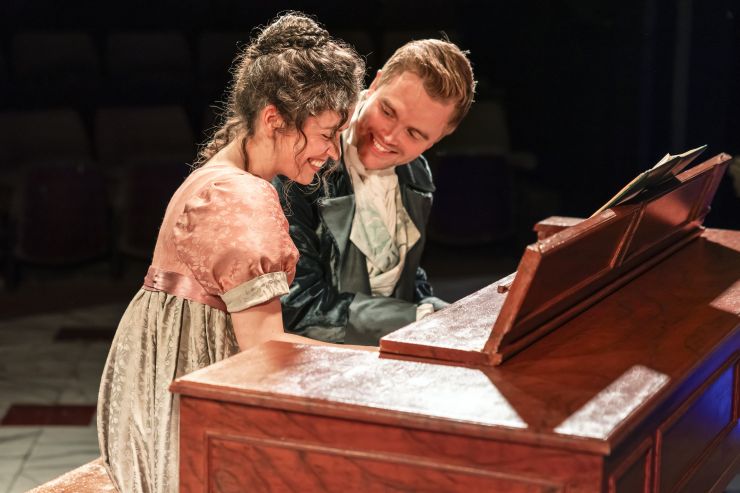
Any fans of Jane Austen’s Pride and Prejudice will instantly recognise the Pemberley of the title as being the home of Mr Darcy and Elizabeth, as the main protagonists of that timeless classic. A tantalising bite of thriller mystery is promised, disturbing their wedded bliss, with no doubt more drama from the scurrilous Mr Wickham who married Elizabeth’s sister Lydia. Following the miniseries adaptation in 2013 of the P.D.James novel and adapted for the stage by Duncan Abel and Rachel Wagstaff, our interest is piqued, our appetite whetted.
However, despite such calibre of writers and high promise, especially since the critical and popular successes of the superb The Girl On The Train, this sadly doesn’t follow through. Jane Austen’s characters are true to themselves in the plot which is gratifying, and James Bye certainly cuts a fine figure of Mr Darcy, instantly recognisable in brooding stoicism even before he speaks. There are various things unexplained in this adaptation, including why two characters decide to agree on a “confession” they heard, when later they claim to be honourable and wanting to help the accused. However, the issue is potentially less one of adaptation and more one of production. The moving backdrop and views out over Pemberley look stunning, yet the sliding backdrop suddenly has a massive gap in it in the prison scene and others, yet part of the view remains, and empty picture frames slide in and out of view. The actors moving the set around do so with slick precision yet the set results in looking unfinished.
The lasting impression of the production is one lacking in overall vision. While there are some nice moments within the piece, there are few changes in rhythm or pace which leaves it a little flat. There are moments of almost panto-esque quality in some of the character portrayals with some actors playing to the audience laughter: which tips this period piece into melodrama, strongly seen in the staging of a key scene towards the end revolving around Elizabeth and a letter. Confusion also appears in the costuming, with much of the costumes being of the period but some not quite finished in attention to detail: most notably the black and white polka-dot dress. It’s as if the ideas of the staging, vision, costuming and much more had started in one direction and then completely changed tack towards another direction, changing a few more times along the way.
Many of the actors double up and some of these don’t quite land. The portrayals are often not different enough from each other for us to know which is which, despite costume and hair changes, yet not shoe changes, which is another missing detail. Sarah Berger was one exception with the haughty and ridiculous Lady Catherine and working class Mrs Bidwell, despite her portrayal of the dowager being more in line with Lady Bracknell than Lady Catherine. Mogali Masuku’s portrayal of Louisa Bidwell is the most authentic and real on the stage: giving us something to really connect with in her vulnerable yet passionate performance. The actors do give the impression of not having been directed as there is a disparate disconnect between them: despite their individual aims to do well in their roles. This is a play which has potential and could be strong, but needs an overall cohesive vision and direction, including some restaging.
Theatre Royal Brighton, 2 September 2025
Death Comes to Pemberley runs until 6 September 2025
Photo credit: Pamela Raith
