
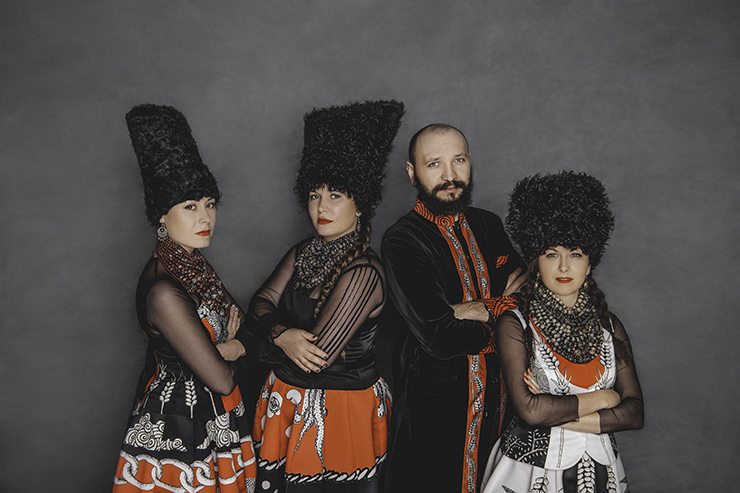
Ahead of their sold out show at ACCA this month, experimental quartet DakhaBrakha share their global inspirations, theatrical origins, and Ukrainian heritage with Brighton Source.
Supported by multi-discipline local artist Bunty, DakhaBrakha are making their ACCA debut in Brighton this January, bringing their beguiling folk music to the south coast. We caught up with the group ahead of their performance, hearing about the last 20 years of creating “ethno-chaos” music, the challenges of playing so many instruments and their feelings on the plight of their homeland…
Credit: Helen Bozhko
Your music is unique, elevated and experimental – how did DakhaBrakha begin?
DakhaBrakha originated from the DAKH Theatre in Kyiv. In 2004, director Vlad Troitskyi proposed to me and the girls, who had been studying and singing folk songs all our lives, to embark on a path of theatrical experiments with authentic songs. Initially, we existed as a purely theatrical performance, but later realised that the music we created could be interesting on its own.
You have an interesting approach to rhythm and harmony – what instruments do you play, and what is your musical background? In which language(s) do you sing?
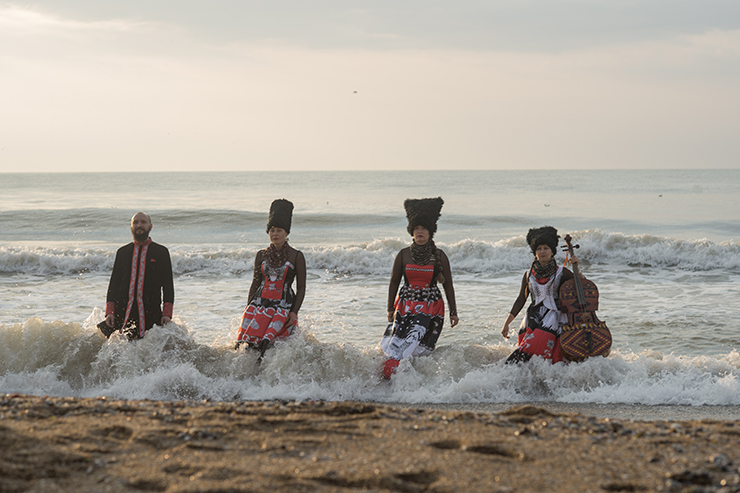
We mostly sing in our native language. However, many of our songs are quite old and contain archaic vocabulary and dialects, so not everyone in Ukraine understands our lyrics. We also sing in Bulgarian, English and a bit of German. As for instruments, we play quite a variety, though we constantly aim to reduce their number. It’s challenging to travel the world with all of them. None of us has a formal instrumental education; we learned to play while creating musical compositions, taking a non-traditional approach that allowed us to discover the possibilities of instruments with a fresh perspective and enjoy every sound.
Credit: Andrei Nemes
Your music has been described as “ethno-chaos” and combines a rich blend of Indian, Arabic, African, and Ukrainian folk instruments and textures – what inspired you to unite these sounds?
The most important instrument for us is the voice. Everything else merely helps us to express ourselves. However, putting Ukrainian songs in unconventional compositions has always been a challenge for us, so we use a variety of instruments.
We’re curious to know how you’d describe DakhaBrakha – what does your music sound like to you? How would you describe your ‘genre’?
It’s challenging for us to describe our music. It seems quite diverse to us. We often explore various genres, so using just one or two words to describe our music is difficult. Lately, I’ve been thinking of an analogy with visual arts. There was a Ukrainian primitive artist, Maria Prymachenko, and our songs seem similarly ‘naive’ in a musical sense.
We read that “DakhaBrakha” can be translated from Old Ukrainian as “to give/take”. What does “to give/take” mean for you as a band?
We take a lot from our roots, from the people we meet and work with, and from substances that are beyond our reach. We give back what is commonly called energy to our audience and listeners. This constant circulation between us and the recipients is what keeps us working.
Credit: Andriy Petryna
Your group has a vibrant visual identity – does theatre still play a significant role in your performance? What do your costumes represent?
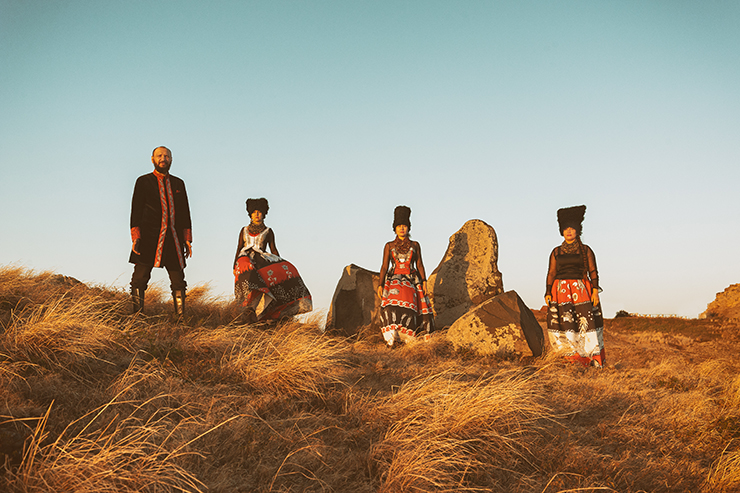
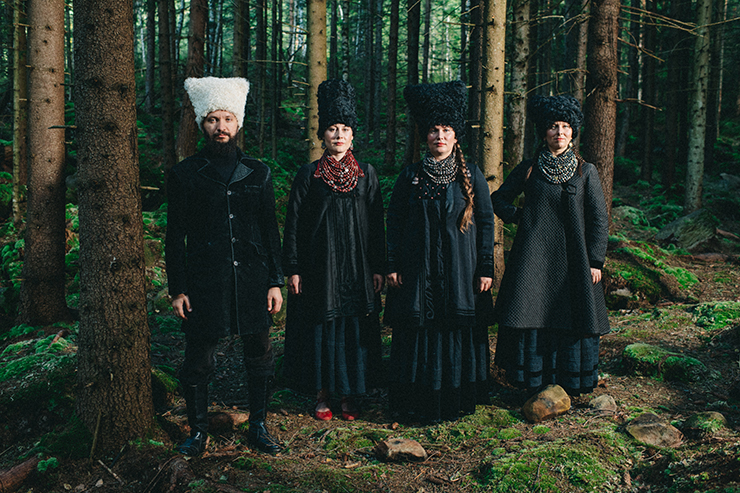
As I mentioned earlier, we come from the theatre, and we still draw a lot from that experience. Many people notice our particularly dramatic atmosphere. Costumes also originated from the theatre and were invented there. They are not authentic but include folkloric elements, similar to our music, which is not purely folk but rather experimental.
We like how you’ve translated the history of regional Ukrainian musical practices and cultural performance into the present – what awaits DakhaBrakha next?
This year marks our 20th anniversary, and we have never tried to predict, program, or build our future in a marketing way. We still enjoy working together, creating new music and touring. Especially now, when we feel that we can contribute to our country. We hope to continue serving the goal of achieving sustainable peace in our country and the world.
Credit: Vitaliy Yurasov
How does your music help unite Ukrainian communities and their allies worldwide, especially in the context of war?
The Russian war in Ukraine has been ongoing for 10 years. Throughout this time, we have been urging the world to stop Putin. We’ve seen the eyes of people who supported us, but there has been very little understanding and action from the politicians of civilised countries to stop the aggression and tyranny of the Russian dictator.
Russia has been occupying parts of neighbouring countries and continuing to do business with them, building new pipelines and perspectives. Only in the last two years, the veil has lifted from people’s eyes, and now everyone understands that today’s Russia poses a huge danger to democracy and could potentially be responsible for countless destroyed destinies worldwide. We are facing the threat of new wars on our planet, and the sooner Western politicians understand this, the more chances there are to avoid significant casualties. Action is needed. Good must have fists because evil must be punished. I understand that the answer to this question is not very comfortable and pleasant, but these are our thoughts that, hopefully, will help awaken the dormant and sluggish Western society.
DakhaBrakha play at the Attenborough Centre on Friday 26th January 2024
More info here
