
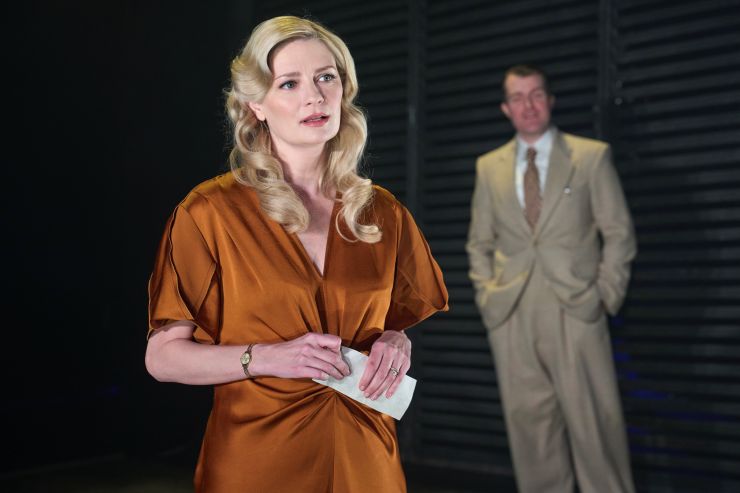
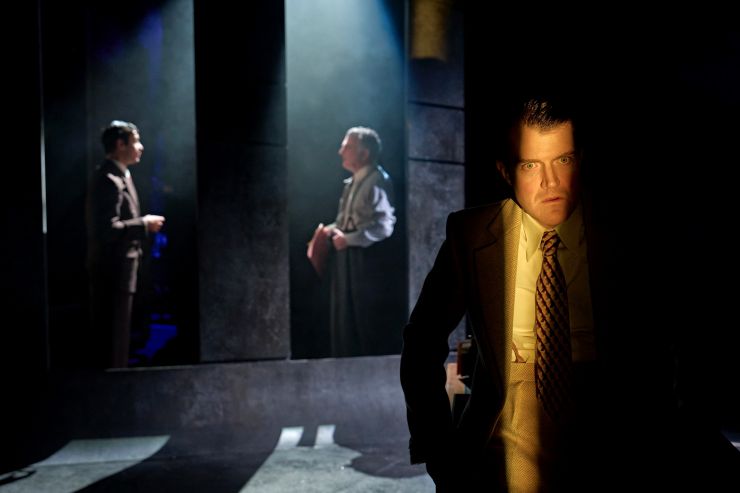
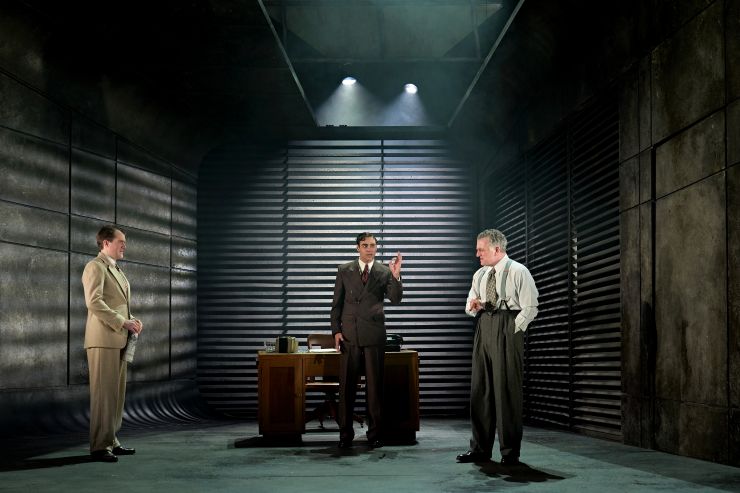
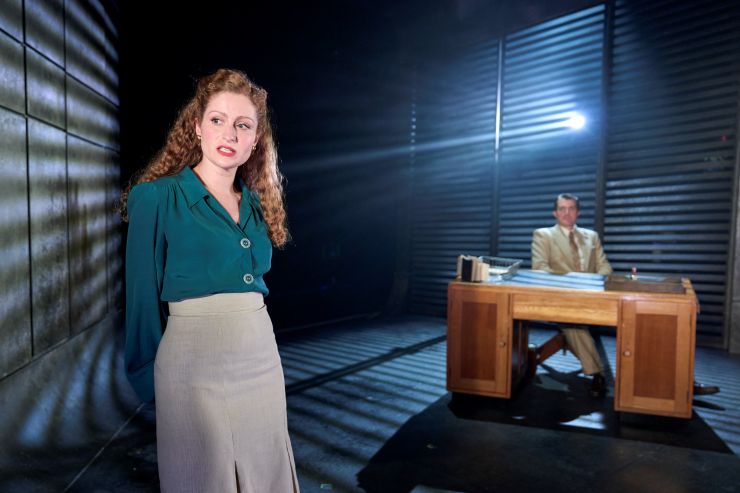
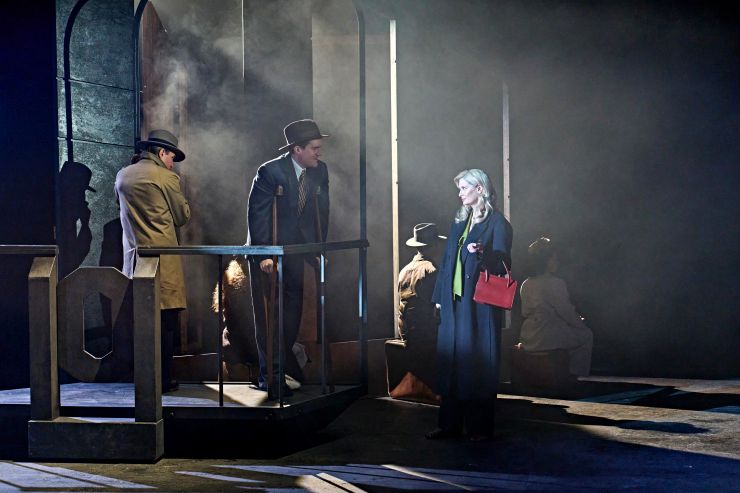
Greed, guilt and betrayal: all key characteristics of the Noir style mostly popularised in films from the 1940s and 50s, and here on stage. The dark cornered set overshadowed by the Hollywood letters from the California hills adds to the brooding quality, as does the mist, plus background saxophone riff at the beginning, and the beautiful lighting design by Joshua Gadsby with the classic slatted light through window blinds we know from this style, casting ominous shadows over the protagonists. The 1944 film is known as the quintessential film noir, with the femme fatale: here played by Mischa Barton, as the central magnetic force around which everything attracts and repels.
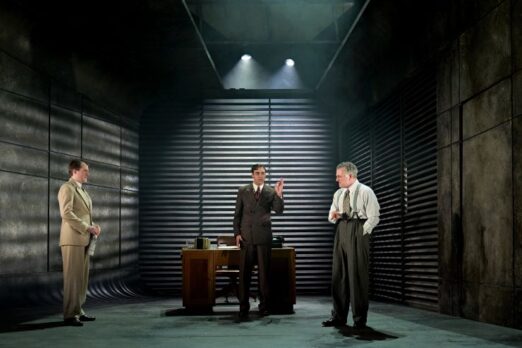
Noir requires the main character’s inner monologue to be audible to the audience, and in this adaptation the manipulated figure of Insurance Man Walter Huff breaks the fourth wall immediately by addressing us, in “this place of dreams” which we interpret to be the theatre. At first this is interesting and exciting, to be drawn into his internal world as if we are there, as he tells the story that has already happened to him, however this changes significantly at one point in the second act and doesn’t quite land, leading to confusion. The second act has more pace and tension and draws us in to his world of not knowing who to trust or who to believe. It’s an interesting adaptation from Tom Holloway and the transitions between scenes, moving people and furniture to change location through the space is gorgeous.
The trouble is that noir style has been parodied so much that it needs something of exceptional skill and talent to use this story style for real: for example, L A Confidential. Having fully complex and rounded characters that we can believe in would help. James M. Cain, author of the original novel, is known for his complex characters, but sadly it doesn’t come across here. Style certainly does, although there are some interesting musical choices, some sounding like Morcheeba from the 1990s rather than instrumental 1940s or 50s, and some with such a loud base it makes the floor and chairs vibrate uncomfortably. Other odd choices include really obvious doubling of some characters, when there are many more understudy or non speaking part actors on stage who could be used for these, giving clarity to the audience about who is who.
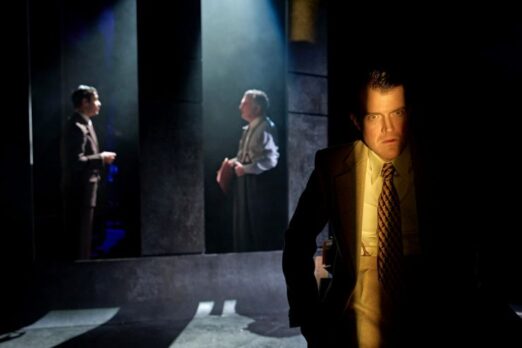
Mischa Barton is physically stunning as the ultimate femme fatale Phyllis Nirdlinger, part Verona Lake, part Faye Dunnaway, although her wardrobe could have been more flattering, fitting and glamorous. We see why Walter Huff’s eye is turned when he sees her, however, this moment could have been built on more and doesn’t follow through. Suddenly these two people who don’t know each other at all are planning a murder as if they are planning a coffee morning. It’s hard to find chemistry between them: lack of physical tension, lingering looks, flirting, sensuality; all could have been layered in. Gillian Saker however, in various roles, notably Secretary Nettie, comes across as a fully rounded believable character, and Sophia Roberts has some strong scenes as Lola Nirdlinger in the second act. Martin Marquez plays a fully rounded character of Keyes with his changing views and compromised integrity towards the end, garnering our sympathy. This is a stylish thriller with potential, with some moments of theatrical beauty, but doesn’t yet deliver all it could.
Theatre Royal Brighton, 10 March 2026
Double Indemnity runs until 14 March 2026
Photos credit: Manuel Harlan
